2008 end-of-year wrap-up

31st December 2008

Everyone appears to do end-of-year wrap-up posts about this time of year, so I thought I would do one too...

January

We started the year with a trip to the zoo. I attempted to get a photo of a waterfall with that blurry water you see the good photographers do.

Waterfall near the seals

February

The highlight of February was talking at the UK PHP Conference in London.

Lunch!

March

A quiet month with most weekends doing something with the family. We went for a walk by the river Severn one weekend. There are many swans.

Swans (and a seagull!)

April

April saw a very nice PHPWM meet-up at a pub that served pies as well as pints. It also snowed.

Snow covered slide

May

May is the month of birthdays in our household as both the boys and myself celebrate. It also marks the start of the camping season for us.

Camping at Kingsbury Water

June

After May, June was a quiet month. Prince Charles took a ride on the Severn Valley Railway though, which I enjoyed photographing.

King Edward on the Royal Train

July

July saw sports day for our eldest son and a week's holiday camping in Norfolk towards the end of the month. I believe that that week in July was the only hot week we had all year.

The beach

August

We went away for our second week's camping and visited Legoland. The kids loved it.

Lego Models

September

A busy month with our youngest starting school. Also, I went to ZendCon!

ZCE Party at ZendCon

October

We started the move to Birmingham for the company with two members of staff there. The Wispa also returned to the shops.

Wispa is back!

November

The highlight of November was speaking at the inaugural PHPNW conference.

Jeremy's about introduce the panel...

December

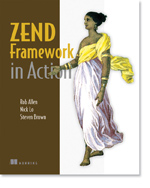
The last month of the year saw both kids in school plays and most importantly, my book about Zend Framework was published!

Zend Framework in Action

Here's to 2009!

On models in a Zend Framework application

13th December 2008

Let's talk about writing models that communicate with databases within a Zend Framework application. It's a popular topic at the moment as there's been a few threads recently on the ZF mailing lists about creating models.

The "is a" relationship

When working with models within Zend Framework, the simplest solution is to extend Zend_Db_Table_Abstract and Zend_Db_Table_Row_Abstract along these lines:

class Users extends Zend_Db_Table_Abstract
{
protected $_name = 'users';
protected $_rowClass = 'User';

public function fetchAllInLastNameOrder()
{
return $this->fetchAll(null, array('last_name', 'first_name'));
}

public function fetchUserById($id)
{
$id = (int)$id;
return $this->_fetchRow('id = '. $id);
}
}

class User extends Zend_Db_Table_Row_Abstract
{
public function name()
{
return $this->first_name . ' ' . $this->last_name;
}
}

This works fairly well for models where there is a one to one mapping to the underlying database table. It starts to falls down if a given model needs to know about two or more database tables to do its work.

The knack is to avoid using the functions defined in Zend_Db_Table_Abstract within your models or views as this will lead towards fat controllers that are too aware of the underlying database. This gets quite hard as it's much easier to start putting model logic into the controllers with this system, especially when it comes to choosing if you need to insert or update a record. A sure sign that you have this problem is that your controllers create SQL statements or Zend_Db_Table_Select objects.

To try and avoid these problems, there have been discussions on the ZF mailing lists for a little while now about using a "has a" relationship from the model object to the Zend_Db_Table object. Bill Karwin has long been a proponent of this idea and recently there's been much discussion about it. The question is: how do you implement it in practice without ending up writing lots of code for the sake of "cleanliness"?

I've started a new ZF project recently where I've started playing with these ideas and this is my first attempt at it, so I thought I'd share where I had got to in my thinking.

The "has a" relationship

When implementing this relationship we are trying to hide the fact that we are using Zend_Db_Table from the consumers of the models. The basic idea is that we have a gateway class that holds a protected $_table variable that is an instance of a Zend_Db_Table object. When fetching data, the gateway object will return either a single object or an array of objects of a type which I've not-very-imaginatively named "StandardObject".

This is a picture of the various objects and how they relate to each other:

OnModels.png

To get this working, I first mapped out how I want the objects to work via a unit test and then built the classes behind it. I wouldn't call it TDD though as I didn't write tests for all the internals as I went along. This is the basic API that I want my consumers to use:

$userGateway = new UserGateway();

// insert a row
$data = array();
$data['first_name'] = 'John';
$data['last_name'] = 'Smith';
$row = $userGateway->setFromArray($data);

// update a row
$data = array();
$data['id'] = 1;
$data['first_name'] = 'Rob';
$data['last_name'] = 'Allen';
$row = $userGateway->setFromArray($data);

// fetch a single user
$row = $userGateway->fetchUserById(1);

// fetch all users
$rows = $userGateway->fetchAllInLastNameOrder();

// delete a user
$result = $userGateway->deleteById(1);

The general idea is that I can write specific functionality into the UserGateway class as I need it. Note also that the row objects returned from the gateway class methods behave a little like ValueObjects only. As they are not attached to the database though, they cannot "save" themselves. (I couldn't find the "correct" design pattern name, which probably means, that my design is wrong!) This means that all interaction with the database is via the gateway class which makes this design similar in some ways to the Table Module design pattern.

The implementation is fairly involved, so get ready for lots of code!

Firstly we need the Gateway class:

class UserGateway extends App_Model_Db_StandardGateway
{
protected $_tableName = 'UsersTable';
protected $_rowClass = 'UserObject';

public function fetchUserById($id)
{
$id = (int)$id;
return $this->_fetchRow('id = '. $id);
}

public function fetchAllInLastNameOrder()
{
$orderBy=array('last_name', 'first_name');
return $this->fetchAll($orderBy);
}
}

The UserGateway contains the specific methods for this model and has a couple of protected variables that are used to set up the system. We also need a table class, UsersTable that inherits from App_Db_Table_Standard which inherits from Zend_Db_Table_Abstract.


class UsersTable extends App_Db_Table_Standard
{
protected $_name = 'users';
}

Obviously we are going to have many gateway models, so it makes sense that common functionality will be in a parent class, which I've called App_Model_Db_StandardGateway. This is the big class and we'll look at it in chunks:


class App_Model_Db_StandardGateway
{
/**
* @var App_Db_Table_Abstract
*/
protected $_table = null;
protected $_tableName = null;
protected $_rowClass = 'App_Model_StandardObject';

public function __construct()
{
if (empty($this->_tableName)) {
throw new Exception('You must specificy _tableName');
}
$this->_table = new $this->_tableName();
}

Every gateway has a $_table property which is instantiated in the constructor. The name of the table class to instantiate is stored in the $_tableName property which is set in the child class. Finally, we have a $_rowClass property which will be used to hold each row object when the data is retrieved from the database. Note that it defaults to App_Model_StandardObject, but I assume that the child class will override with a specific row class as the UserGateway class does when it specifies that it wants to use the UserObject row class.

The first thing in our API is the ability to create or update database rows. I've decided on a function called setFromArray() as a foundational function to allow this. The base implementation is performs these steps:

  1. Get hold of an instance of the row class
  2. Call the row's setFromArray() method
  3. Call the row's save() method

This is implemented as:

// (part of App_Model_Db_StandardGateway)

public function setFromArray($data)
{
$row = $this->_fetchRowOrCreate($data);
$row->setFromArray($data);
$row->save();

return new $this->_rowClass($row->toArray());
}

The tricky bit is getting the instance of the row class (an instance of Zend_Db_Table_Row) as we need to either create a new one or retrieve it from the database. Creating a new one is easy: $row = $table->createRow(). However, retrieving a row based on the $data array is more complicated. The simplest way I could think of was to retrieve the primary key info from the table and then call find() with the correct fields from $data array. To do this, I had to extend Zend_Db_Table_Abstract to implement a getPrimary() method like this:


class App_Db_Table_Standard extends Zend_Db_Table_Abstract
{
protected $_rowClass = 'App_Db_Table_Row_Standard';

public function getPrimary()
{
return $this->_primary;
}

}

Note that we also define a custom row class, App_Db_Table_Row_Standard which will allow us to perform operations on insert and delete.

Back to the App_Model_Db_StandardGateway class, we can now create _fetchRowOrCreate():

// (part of App_Model_Db_StandardGateway)

/**
* Either retrieve a row from the DB or create a new one
*
* @param array $data
* @return App_Db_Table_Row_Standard
*/
protected function _fetchRowOrCreate($data)
{
$pk = $this->_table->getPrimary();
if (!is_array($pk)) {
$pk = (array) $pk;
}

$pkData = array();
foreach ($pk as $fieldName) {
if (array_key_exists($fieldName, $data)) {
$pkData[] = $data[$fieldName];
} elseif (!empty($pkData)) {
throw new Exception("Could not find Primary Key part '$fieldName'");
}
}

if (empty($pkData)) {
$row = $this->_table->createRow();
} else {
$rowset = call_user_func_array(array($this->_table , 'find'), $pkData);
if ($rowset) {
$row = $rowset->current();
} else {
$row = $this->_table->createRow();
}
}
return $row;
}

I'm nearly sure this can be improved, but it works for both a simple autoincrement primary key like id and also for compound primary keys of multiple columns which is nice. The method makes an assumption that if you have a compound key, then the $data array will have an entry for all fields that make up the primary key. If not, an exception is thrown. We also assume that if none of the fields that make up the primary key are present in $data, then you want to create a new record.

That covers creating and updating database records from our gateway class. Deletion is a simple proxy directly to the table class:

// (part of App_Model_Db_StandardGateway)

public function deleteById($id)
{
$count = $this->_table->delete('id = '. (int)$id);
return (bool) $count;
}

so let's look at fetching data. We need two methods in the App_Model_Db_StandardGateway class: _fetchRow() and fetchAll(). These are trivial to implement as we proxy directly to the table class and then all we need to do it turn each row returned into an instance of our StandardObject class:


// (part of App_Model_Db_StandardGateway)

protected function _fetchRow($where, $order = null)
{
$row = $this->_table->fetchRow($where, $order);
if ($row) {
$row = new $this->_rowClass($row->toArray());
}
return $row;
}

public function fetchAll($orderBy=null)
{
$rows = null;
if(is_null($orderBy)) {
throw new Exception('You must choose the order of the results');
}
$rowset = $this->_table->fetchAll(null, $orderBy);
if($rowset) {
$rows = array();
foreach($rowset as $row) {
$rows[] = new $this->_rowClass($row->toArray());
}
}
return $rows;
}

The StandardObject class' full name is App_Model_Db_StandardObject and is trivial:

class App_Model_Db_StandardObject
{
function __construct($data = array()) {
foreach($data as $fieldName=>$value) {
$this->$fieldName = $value;
}
}
}

Obviously, the intention is that the model specific version, UserObject in this case, is able to do provide model specific functionality. For testing, I simply added a name() method:

class UserObject extends App_Model_Db_StandardObject
{
public function name()
{
return $this->first_name . ' ' . $this->last_name;
}
}

Clearly, I could provide additional methods as required and could overload the constructor if I wanted to do a more complicated mapping from the database row array to the value object representation.

Summary

This entry has turned out much longer than I expected! This is clearly my first attempt at putting the database inside the model and hiding it from the rest of the application. Having implemented this far, I'm not sure if using Zend_Db_Table is actually useful, so my next step will be to remove it and use SQL and a Zend_Db_Adapter instead. If it turns out well, I may blog about it :)

I'm also hoping to spark more debate on the actual implementation of how to do stuff like this. I know Keith Pope is working along similar lines for the example app in his upcoming book, so if you are interested in this approach, have a look at his tactics too as they may make more sense. Matthew Weier O'Phinney has also been doing something similar in his pastebin app which is worth looking at too, though he's halfway through refactoring.

Obviously, comments and suggested improvements are welcome!

File uploads with Zend_Form_Element_File

29th November 2008

Now that Zend Framework 1.7 has been released, I thought I'd take a look at the built in file upload element, Zend_Form_Element_File, and see how it can be used. This is how to use it in its most basic form.

I decided to use the same set of form elements as before in order to make things easy.

Zend_Form_Element_File_Example.png

Let's start with the form:

The form

We extend Zend_Form and store it in the application/forms folder and so the class name is forms_UploadForm:


< ?php

class forms_UploadForm extends Zend_Form
{
public function __construct($options = null)
{
parent::__construct($options);
$this->setName('upload');
$this->setAttrib('enctype', 'multipart/form-data');

$description = new Zend_Form_Element_Text('description');
$description->setLabel('Description')
->setRequired(true)
->addValidator('NotEmpty');

$file = new Zend_Form_Element_File('file');
$file->setLabel('File')
->setDestination(BASE_PATH . '/data/uploads')
->setRequired(true);

$submit = new Zend_Form_Element_Submit('submit');
$submit->setLabel('Upload');

$this->addElements(array($description, $file, $submit));

}
}

Note that BASE_PATH is not automatically defined within Zend Framework, so you would have define it yourself within your bootstrap.

As before, we set the name and enctype attribute of the form to allow for files to be uploaded. The form itself has two fields: a text field called 'description' and the file upload field called 'file', along with a submit button. Nothing especially complicated here.

The Zend_Form_Element_File element has a setDestination() method which is used to tell the underlying Zend_File_Transfer_Adapter_Http where we want the file that is uploaded to be stored. In this case we choose data/uploads.

The controller & view

The controller is also very standard:

< ?php

class IndexController extends Zend_Controller_Action
{
public function indexAction()
{
$this->view->headTitle('Home');
$this->view->title = 'Zend_Form_Element_File Example';
$this->view->bodyCopy = "

Please fill out this form.

";

$form = new forms_UploadForm();

if ($this->_request->isPost()) {
$formData = $this->_request->getPost();
if ($form->isValid($formData)) {

// success - do something with the uploaded file
$uploadedData = $form->getValues();
$fullFilePath = $form->file->getFileName();

Zend_Debug::dump($uploadedData, '$uploadedData');
Zend_Debug::dump($fullFilePath, '$fullFilePath');

echo "done";
exit;

} else {
$form->populate($formData);
}
}

$this->view->form = $form;

}
}

The view, views/scripts/index.phtml, is trivial:

<h1>< ?= $this->title; ?></h1>
<?= $this->bodyCopy; ?>
<?= $this->form; ?>

If the form validates correctly, the $uploadedData array will contain the values of the form fields along with the filename of the file that was uploaded. Note that this filename is not fully qualified, so if you need the entire path to the file, then use the getFileName() method on the file element.

Conclusion

That's all there is to it for simple uploading of forms. There are still a few fairly important bugs in the component that we'll have to wait for 1.7.2 for. Specifically the Count validator doesn't always work as you'd expect and don't use getValues() and receive() as it isn't yet clever enough to know not to call move_uploaded_file() more than once.

As usual, here's a zip file of the project I created to test this: Zend_Form_Element_File_Example.zip (including Zend Framework (a snapshot of the release-1.7 branch) which is why it's 3.9MB large).

PHPNW08 Conference

24th November 2008

PHPNW 08 took place last Saturday, and even though I wasn't too well, I had a great time.

I thought my talk went okay, and judging from the feedback, at least some people learnt something from it which is good. I hope that the tongue-in-cheek references to my book were taken in the light-hearted manner intended. The conference seemed well-attended and the organisation was top-notch. Jeremy, Jenny, Emma, Lorna and everyone else involved did a fantastic job.

At both socials, I met some excellent people who were generous enough to let me be my usual opinionated self and so I learnt as much at the socials as I did in the sessions.

One side effect of being ill is that I didn't take many photos. The few I did take are up on Flickr.

The slides for my talk are up on slideshare too:

View SlideShare presentation or Upload your own. (tags: zendframework phpnw08)

Hooks in Action Helpers

5th November 2008

Following on from the discussion on Zend Framework Action Helpers, let's talk about hooks within them.

Hooks are a feature of action helpers that allow you to automatically run code at certain points in the dispatch cycle. Specially, there are two hook functions available for action helpers:

  • preDispatch(): runs before the action function is called
  • postDispatch(): runs after the action function has completed

These allow you to ensure that some functionality is always run for each request. Let's consider a simple example of displaying a random quote in the footer of a website.

We start with an action helper in our controllers/helpers directory called Quote:

<?php

class Zend_Controller_Action_Helper_Quote extends Zend_Controller_Action_Helper_Abstract
{
function preDispatch()
{
$view = $this->getActionController()->view;
$view->footerQuote = $this->getQuote();
}

function getQuote()
{
$quotes[] = 'I want to run, I want to hide, I want to tear down the walls';
$quotes[] = 'One man come in the name of love, One man come and go';
return $quotes[rand(0, count($quotes)-1)];
}
}

The preDispatch() method, collects the view from the action controller and then assigns a random quote to the footerQuote property.

We need to tell the helper broker that we want this helper's hooks to be run, so in addition to the addHelperPath() call, our bootstrap requires a call to addHelper(). The bootstrap therefore has this code within it:


// Action Helpers
Zend_Controller_Action_HelperBroker::addPath(
APPLICATION_PATH .'/controllers/helpers');

$hooks = Zend_Controller_Action_HelperBroker::getStaticHelper('Quote');
Zend_Controller_Action_HelperBroker::addHelper($hooks);

As we used addPath() to tell the helper broker where to find the action helpers, we can use getStaticHelper() as an easy way to instantiate the class without having to require() and then call new. We can then register it with the helper broker using addHelper().

As the quote is displayed in the footer, the HTML required lives in layout.phtml:

<div id="footer">
<div id="quote">
<?php echo $this->footerQuote; ?>
</div>
</div>

That's it - not too hard, is it?

Zip Files:
I've updated the example project from the last post so you can see it in context.